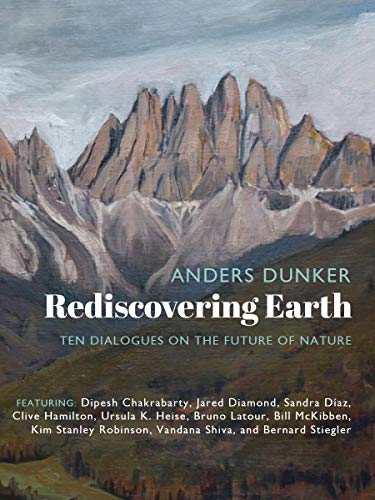
This book lent to me by a friend is a series of conversations between the author – Norwegian writer and journalist Anders Dunker – and various scientists and academics about climate change and nature.
I only managed to read one conversation – with Jared Diamond, an American geographer, historian, ornithologist and author – before I needed to give it back, but it left me wanting to finish the whole book. Here are some of the key insights garnered.
How humans react in a crisis
In reality, climate change requires us to make huge personal and social changes, much like the pandemic has. We can make them gradually or be forced to make them drastically, as with covid.
Diamond believes that it usually takes ‘a big jolt to make people adopt’ major life changes. To explain further, he uses the following analogy. He describes people responding to the danger of a dam bursting. The closer people live to the dam the more worried they become. Yet those who live right under the dam are not scared at all. They are in denial.
According to Diamond, the best course of action would be to move away from the danger of the dam. But the second-best thing would be to live in the house and deny there is a problem, rather than stay in the house and constantly worry about it. I am not entirely sure what to make of this, other than that he is suggesting the best outcome is to act (move house), but the second best thing is to not worry too much about the things you perhaps can’t act upon. You might have a different interpretation.
Science is rarely straightforward
Diamond and Dunker discuss how important knowledge is in galvanising people and societies to make the necessary changes but that this information is not always straightforward – again as we have seen with the pandemic.
Part of the climate change debate thirty years ago (and even now, I’d add) was about whether climate change is man-made or not. Back then, not all good scientists were convinced it was because the warming on average was fluctuating year-on-year, rather than, for example, presenting in a graph as a nice straight diagonal line pointing upwards. Some believed, before they became convinced by the signals behind the data, climate variations were just normal fluctuations and not man made.
Today, some intelligent people STILL believe that, effectively denying the existence of man-made climate change. However, as Diamond explains, changes in weather patterns are normal but we are experiencing them at a greatly accelerated rate: “The response to that is that the rate of change is a thousand times what it has been for the last ten-thousand – even million – years.”
This is a good answer to have in your arsenal when people try to deny climate change is a genuine threat.
Follow the science
In relation to understanding and adequately reacting to the science, Diamond says: “In a perfect world, science would put the relevant facts on the table, the information would be distributed, and the public would make reasonable choices that would be acted upon by the political body. But lots of things interfere in that process.”
That last bit…’lots of things interfere in that process’ we have had a heightened experience of in the last 18-months. Yet, looking at it more positively, the pandemic has shown that governments and people can make huge transitions in a short space of time if they understand the risks presented and the urgency needed to mitigate them.
So at least we know it is possible, if not very easy. But I’m not convinced every one, including government, yet understand the urgent threat climate change presents.
Could society collapse?
I have to say, I’ve read a lot about climate change, but I never really thought about the collapse of society in great detail, even though many experts allude to this happening. They just never outrightly say the ‘collapse of society’. As the mother of a two-year old, this makes for very difficult reading as my child will be around my age (30s) when things could get really bad.
But, as Diamond points out, lots of societies before us collapsed: the Mayans, Incans, Romans etc. These societies, however, used to live in isolation of each other. Often when one crumpled, others didn’t notice because they never knew they existed in the first place. That would never happen today. Our interconnectedness wouldn’t allow for it. If a society collapses today, they don’t disappear altogether because the stronger countries (the rich ones) send aid and other forms of support to help them.
But what happens when the rich countries collapse, which is what climate change threatens? “Then they will take other countries with them,” says Diamond.
Does he think this will happen, that global society will collapse like in some apocalyptic movie?
He caveats his answer by labelling himself as an optimist, as many climate scientists do. (He brought children into this world, after all, he explains).
“I see the chances as 51 percent that 30 years from now you’ll find a world worth living in, 49 percent that you won’t want to be alive.”
Gulp! With these odds I feel bad for bringing a child into the world! But perhaps I should instead feel hopeful that there’s still a fighting chance to turn things around.
 Climate Change Site